

This is Part II in a series of autobiographical essays tracing the different parts of my life. If you haven’t read Part I, I’d encourage you to start there.
“The body knows things a long time before the mind catches up.” —Sue Monk Kidd
It is hard to say what turns ordinary worry into panic, or what unseen line the mind crosses before fear takes residence in the body and becomes something larger and more consuming. But once it does, it moves in quietly—the way darkness overtakes a room at dusk—claiming its place as though it had always belonged, until panic begins to speak for the body.
For those who have never felt the swell of panic, it can be hard to understand. Panic does not announce itself with consistency or reason. It can manifest differently for different people. For me, it is pernicious and physical. It can arrive anywhere—at a movie theater, in an Uber, during a meeting, upon waking in the morning. There is no reliable trigger, no clear warning, only the sudden, unmistakable sense that something inside me has gone awry.
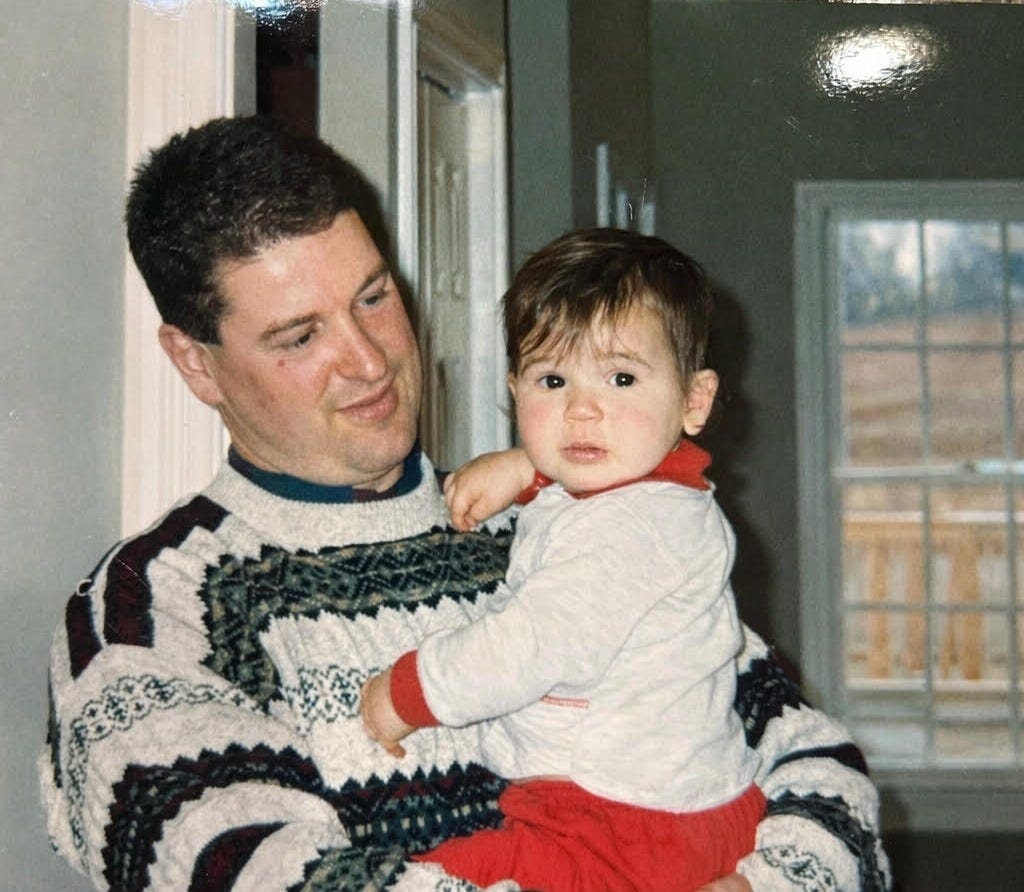
For most of childhood, or at least the part I remember, my parents were separated and I lived full-time with Mom. During those years, I yearned to spend time with Dad—to feel the unmistakable bond between father and child. Yet even then, my body knew something my mind did not. Each time Dad was to pick me up, my body grew tense; and when I knew he was on his way, it would revolt. My heart began to beat so hard I could feel it in my ears. A lightheaded sensation would rise in my chest, as if the air itself was thinning.
It is a very particular feeling—panic, that is. The chest grows heavy and exhausted. The stomach twists into knots and the insides churning to the rhythm of tachycardia. The nose and mouth feel constricted, as if covered by a semi-permeable plastic wrap, making each breath deliberate and labored.
One particular instance stands out—not because it was unusual but because it was so ordinary.
I was at Mom’s office after school, pretending the empty office next door was mine as I so loved to do. Dad called to say he was on the way to pick me up for the weekend. The mere anticipation of time together—time I desperately longed for—sent me barreling to the bathroom, doubled over, my body suddenly at war with itself. I couldn’t leave the bathroom. Dad waited for me in the parking lot. Knowing he was there—not just on his way but there—only led my body to revolt even more, as if some hidden alarm clock was going off, warning me of a danger I didn’t yet know existed. Was I sick? Was it food poisoning or the stomach flu? Or was it something more sinister—a truth my body knew before my adolescent mind could comprehend?
There is a certain cruelty in the body’s wisdom—how it speaks in tremors long before the mind can understand why. I loved Dad; I longed to spend time with him. And yet somewhere deep within the hidden chambers of my mind, I understood that to be with him was to step onto uncertain ground. One could never be sure which version of Dad would arrive—sometimes tender, sometimes volatile, and often not quite the version of him I hoped for.
No one teaches a child how to reconcile such disparate realities—indeed, the small and striving mind of a child, still growing and malleable, is not equipped to understand that sort of complexity. Yet still, children know a great deal about the world around them long before their brains mature in full. They know in their body, in their breath, in the tightening of their gut, in the trembling of their hands. They know in the silence between words and in the glaring eyes of a parent. And I knew—without knowing exactly—that while I loved Dad, my body feared him. Both were true.
That is the cruel inheritance of love when it is uncertain: it drives you toward fire for its warmth, even as it sears your skin, because the child’s heart would rather be burned by a parent’s love than to live without it. Love, tangled and unadorned, can wound as faithfully as it warms.
Only years later I would come to know the sensations I felt as panic attacks—back then they were simply my body’s way of speaking. But what my body learned as a child never fully left me: the quickening pulse, the tremble in the hands, the breath caught somewhere between the chest and throat, the opaque white color my skin turned when nausea climbed from depths of my stomach to the back of the throat.
When panic grows inside, the experts, in the kindest way possible, tell you to steady yourself—to master the body’s rebellion with the quiet science of breath. In the sterile language of medicine, it is called “cyclic sighing,” a fancy term for a way of breathing. You draw in air through the nose until your lungs are stretched, then take another small sip of air—just enough to expand the diaphragm to its full capacity—and release it slowly through the mouth until nothing remains but the hollowness of your lungs.
Medical experts say it activates the parasympathetic nervous system, which is the body’s built-in recovery mechanism that slows the heart and steadies the breath when fight-or-flight takes hold. They tell you it is science, a way to trick the body back toward stasis. But what they do not tell you—what cannot be measured or explained in sterile medical terms—is that sometimes, even for those who don’t believe, it feels like a kind of prayer. It is not a request for deliverance but a desperate hope that the moment, that the feeling will pass, that the body still remembers how to be quiet again—that relief, however brief, is still possible.
At first, my panic attacks seemed connected to particular circumstances like spending time with Dad. But they soon began to occupy more and more space in my life. In the latter half of elementary school, I spent countless mornings in the front office of Blue Grass Elementary, begging Mom to pick me up from school. My stomach twisted; nausea rose like a tide I could not hold back. I pleaded to go home—to return to Mom, the only place that felt like refuge.
For a period those pleas were a near-daily occurrence. I was a deeply happy child but also one that seemed to be falling apart—yet there was no fever, no injury or ailment anyone could name. No one quite knew what to make of me, and so in a final attempt to pin my suffering to something concrete, Mom took me to the Children’s Hospital for blood tests. They came back perfectly normal. What plagued me was something lab results could not detect. So I carried on sick without being sick, a child whose body was speaking a language that evaded recognition.
As I grew older, anxiety seeped into almost every corner of my life. Like any kid, I traversed the neighborhood with friends, got invited to sleepovers, and tried to move through the world as if I were like everyone else. But there were signs that something was off. It became a small mystery among my friend’s parents why I was the one kid who never stayed the night even when all the others did. I invented excuse after excuse, but the truth was something I couldn’t fully explain. Each time I agreed to stay over, I would arrive and enjoy the evening just fine—that is, until bedtime crept close and panic began to consume me.
While my friends played video games or drifted asleep, I hid in the bathroom to call my mother, begging her to come pick me up. One night, I distinctly remember slipping out of my close friend’s house at the edge of midnight. I was not yet brave enough to walk the dark alone, so once I summoned whatever courage I had, I eased the door shut behind me and sprinted off into the darkness—my heart pounding, my mind convinced that I was fleeing danger even if no one was there to see it.
My anxiety also manifested in other, less physical ways. For a brief period, I was terrified of being home alone. It was an odd, illogical sort of fear because I felt perfectly safe outside; and so on summer days, I would sit in the driveway hitting tennis balls against the garage door or throwing baseballs against the side of the house, waiting for someone to come home. It was the irrationality of this fear that is most curious. By any reasonable measure—whether inside or outside—I was never actually in danger. If anything, being outside was more dangerous, a fact explained to me more than once in that patient, serious tone reserved for children who refuse to see reason.
Yet the thought of being alone inside our house—of being enclosed by its walls—somehow felt more threatening than anything that could meet me in the open air. Why is something I still don’t fully understand. But fear and anxiety do not obey the laws of probability or common sense; they follow the hidden contours of the mind, answering to truths yet to be articulated.
I was scared almost constantly during this time. On numerous mornings, I would slip through the shared bathroom into my brother’s room to lay on the carpet floor between his bed and the window. We were the only ones home, and the only way I felt safe—to find some sort of stasis—was to hide between him and the door. My brother was a menace to me growing up, an endless source of small, petty miseries. He took delight in getting on my nerves any and every way possible. Yet his adoration for me was always evident and unwavering, and in moments like these—and in moments when my fear was justified—he was someone I hid behind instinctively.
That fear followed me in other spaces, too. One weekend I was home alone for the day and did not expected anyone home until the evening. I spent the morning on the living room couch watching The Office, though “watching” is not quite the word. My eyes were on the screen but my mind was wandering—uneasy, alert, listening for every sigh and creak of the house. For hours, I startled at shadows and mistook gusts of wind for an intruder. Then came the sound I feared most: the giggle of the front door. A metallic tremor. Someone trying to get in. I stood behind the wall of the adjacent room, watching the door handle jerk and twist as though someone was picking the lock. I had been wrong so many times before, had talked myself down from so many false alarms, that even in the moment I wondered if what I was seeing was real or imagined. But then the door popped open, daylight breaking around the door frame, and my worst fear became real. Someone was inside—someone who did not belong there.
What happened next felt less like bravery than instinct. I leapt from behind the wall and threw my body into the door, slamming it shut with every ounce of force my 100-pound body could gather. I heard a scream—a sharp, startled pain. Once the door was locked, I pressed my face to a narrow window and saw a dark-haired man with his back to the door. Then I began to recognize a voice. When the man finally turned around, clutching his wrist, there stood my oldest brother staring back at me with eyes filled with a mixture of shock and fury.
Fear does strange things to the body. It does not ask for permission. And when terror rises high enough, when it floods every aspect of your mind, the body lets go. Non-essential functions fall away and control of the body dissolves. So it wasn’t until I unlocked the door and let my brother inside that I realized my shorts were wet and I was stilling in a pool of urine.
The world teaches us to call this shame, to treat it as a failure of will. But it is not a weakness; it is part of our evolutionary history and the human body’s oldest instinct speaking in the only language it knows: to survive. Long before any of us learned the names for fear, the body learned to make itself lighter, to flee faster, to startle a predator long enough to escape. Many who have faced fear, both real and perceived, have spoken of this—of how the body lets go in those moments when one’s courage demands more of them than their body can bear. The body makes decisions before the mind can form a thought. We all carry that same ancient reflex. At first, my brother was furious—understandably so, since I had slammed his wrist in a door—but he ultimately saw the wreckage of my fear for what it was. He later told me that what I did was, in its own way, brave.
What I did not yet understand—what I would not understand for many years—is that panic is rarely born from nothing. It is not the mind inventing danger for sport. More often, it is memory without language, fear without chronology. The body, faithful and sophisticated, keeps watch long after the threat itself has learned how to hide. And so the panic that followed me through classrooms and bedrooms, through sleepovers and empty houses, was not wandering aimlessly. It was orbiting something. It was waiting for me to be old enough to look back and see what it had been guarding me against all along.
My anxiety manifested in psychological ways, too. One of the cruelest features of Dad’s addiction was his ability to vanish for days at a time. I would call again and again. Each time my call went unanswered tightened a knot inside me. After a couple of days with no communication, I asked Mom to drive me to his house—a child’s version of a welfare check, born of worry and a hope I could never quite shake.
When we pulled up, his truck was parked in its usual spot. I stepped out into the winter cold and knocked on the front door. Still, nothing. So I did what I had done many times before when he’d locked himself out or when I needed something from the house when he wasn’t home: I crawled through the dog door into the finished garage upstairs. The cold hit me first—his house was only a shade warmer than the air outside—and then the familiar musk of stale cigarette smoke, a scent that clung to him and seemed to seep into the walls themselves. I opened the door from the garage into the main house and almost immediately Auggie greeted me with a gentleness that only made the silence feel more ominous. I walked down the dark hallway to the master bedroom: it was empty, save for the usual heap of clothes on the bed. The living room was the same—empty but for the flicker of King of the Hill playing on mute, like the house were trying to impersonate life in Dad’s absence.
I finally reached the guest room—the place where I slept when I stayed over, where I had so often dozed off waiting for him to emerge from the hallway bathroom—and I cracked open the door. In the darkness I could make out the faint outline of a body on the bed. So I stepped inside and tapped his shoulder, then shook him lightly when he didn’t move. When he didn’t wake, my first thought—cold and immediate—was that he was dead. And then without warning, he erupted. He shot up and screamed—something to the effect of “Get the fuck out!”—in a voice so raw and feral it seemed almost inhuman. It was a scream unlike anything I had ever heard before. The closest comparison is the chainsaw-wielding man in a haunted corn maze, except this was worse—far worse—because here there were no actors or boundaries. Dad never hurt me, and I never honestly feared that he would. But his display of pure, unadulterated anger was unforgettable.
One of the hardest realities to accept is that the body is often right long before the mind is ready, or even capable, of believing it. As a child, I mistook its warnings for weakness and its resistance for betrayal. I wanted my fear—my anxiety—to be an error, something that could be corrected or disciplined out of me. But fear, I have since learned, is not always a malfunction of the spirit or the nerves; sometimes it is the most honest form of knowledge we possess.
What my body learned in those early years—about uncertainty, about absence, about love that could vanish without explanation—never truly left me. It did not fade with time or yield to reason. It settled instead into muscle and breath, into reflex and instinct, embedding itself in the quiet places where memory outlives language. Even now when panic rises without invitation, it carries with it the residue of those lessons: that love can be unpredictable, that safety is never guaranteed, that silence can speak with many voices at once.
And yet the body remembers something else as well. It remembers how to endure. How to steady itself, if briefly, when the world feels unmoored. How to find small islands of quiet when certainty is nowhere to be found. This, too, is an inheritance—less visible or discussed but no less real—and it is the one that makes living possible.
That is what it means to live with fear without surrendering to it: not to erase what the body has learned or to deny how darkness can shape us, but to listen more carefully to what that darkness is trying to teach. To bear one’s light without pretending it was found easily or without cost. To recognize that panic, for all its cruelty, can be—and often is—one of love’s most distorted expressions: a vigilance born not of apathy or weakness, but of the simple, enduring truth that what gives us life can also shape our wounds.
Your descriptive abilities to put into words is magnificent. I had tears in my eyes reading.