

A Note From Me:
I used to write a lot about my personal life when I was younger. But for a variety of reasons, I stopped. It is, after all, much easier to keep things to yourself and beyond the reach of others. But there’s also a quiet cost to self-containment—and something liberating about articulating your experiences and putting them out into the world. It’s an act of exposure, yes, but also of reclamation.
Since college, I’ve kept a journal filled with fragments of my life: moments I’ve tried to make sense of, questions I’ve wrestled with, small turning points that, taken together, shaped the person I am today. For years, I imagined gathering those fragments into a memoir. Perhaps that is still in the cards. But for now, I’ve decided to begin to share some of them here, in addition to my usual writing on politics, housing, and the rest.
I’ll distinguish these essays using the same name as the folder where they live, and the title I would give a memoir if I ever get around to writing one: (Re)Creating. The title is a reference to the idea that our lives are a continuous process of creating and recreating—that we are shaped not just by what happens to us, but by the ways we make sense of it and carry it forward.
I hope you find something of value within it.
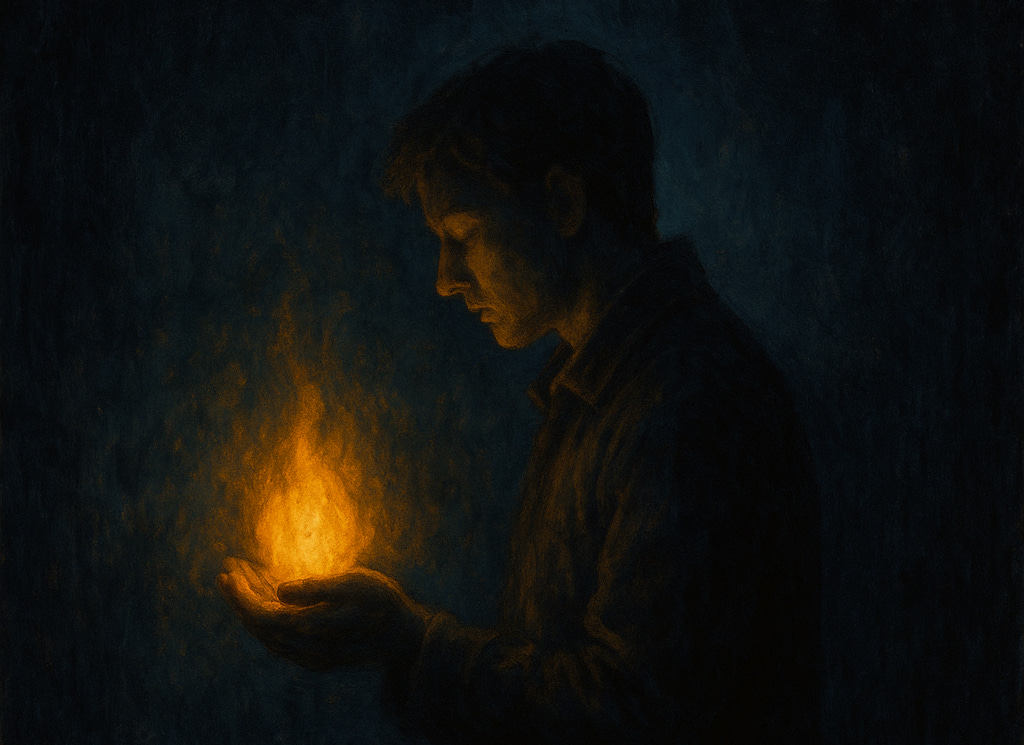
“One discovers the light in darkness, that is what darkness is for; but everything in our lives depends on how we bear the light. It is necessary, while in darkness, to know that there is a light somewhere, to know that in oneself, waiting to be found, there is a light.” —James Baldwin
There I was. Face down in the backseat of Dad’s white Ford F-150 with his hand forcing my torso into the floorboard of the back seat. Whether believed or not, his gesture created the illusion that somehow he could protect me from the man with a gun pointed directly at his chest. I looked up just once, catching only a glimpse of the black and silver handgun and the scrawny little man with his hands wrapped around its trigger.
I can’t recall if I recognized him. Maybe I did. I can’t say for sure. By then, my body was overtaken by the pounding rhythm of fight-or-flight. My heart was thumping too hard and too fast to think clearly—not because I was scared, per se, but because the intensity of the encounter grew slowly and then erupted all at once. The man with the gun had approached the truck with one of Dad’s employees—someone I had encountered many times before, usually in more amicable circumstances, and who, a few months later, would disappear after embezzling thousands of dollars from Dad’s company. Or at least that’s the story I was told.
I don’t remember exactly how old I was. Old enough to remember, but not old enough to know that it was an experience I should have told Mom about no matter how many times Dad asked me not to. He often asked me not to tell Mom things. Withholding the whole truth was a white lie after all. And a white lie was a harmless lie, he told me. Lies were okay if they didn’t hurt anyone.
Other times were more innocuous but no less unnerving for a child—like when he would lock himself in the bathroom when I spent the night. He would slip away quietly and only after my attention drifted from the living room television—where The Twilight Zone reruns played endlessly in the background—did I notice the bathroom door was closed. The exhaust fan hummed steadily, and a thin line of light seeped out around the doorframe. On the good days, he would reemerge after a few minutes. But on other days, he stayed sealed in that small, stuffy hallway bathroom for what felt like eternity. I would wait and wait. Eventually, I would knock. On the worst nights there was only silence. After enough time passed, anxiety would wash over me. I would bang on the door, begging him to emerge from the black hole that seemed to swallow him.
Alone in his living room, I would make sure the deadbolts were latched on every door. Aside from his dog, Auggie, I was entirely alone—and the weight of that silence wrapped itself around me. It was a strange, perplexing sort of abandonment. So often parents who leave do so permanently and without a notice, escaping into a new world, lost to everyone but themselves. But here, no one was lost. There was only a door—thin and tangible—between us. Knowing he was just on the other side, immersed in a world entirely apart from mine, yet unable or unwilling to be reached, made it all the more disconcerting. I couldn’t understand why he disappeared into that tiny hallway bathroom or why he wouldn’t answer my pleas—why he couldn’t offer even the smallest sound or faintest sign of life—partly because I didn’t yet understand the nature of the sickness that consumed him, or that he was sick at all.
Once it was dark, the sun having safely retreated beyond the horizon, I would retire to the guest room where I slept—its door directly across from that hallway bathroom. With Auggie curled up at the foot of the bed, I would lie there quietly, waiting, hoping to hear the soft squeak of the bathroom door as it reopened. But more often than not I’d fall asleep to silence, only to be woken the next morning by a tap on the shoulder and Dad’s smile, greeting me as if the night before never happened.
Despite whatever had occurred the night before, I loved to spend the mornings with Dad and his employees. He owned a tile company—We Tile It, a name as corny as it was endearing—that he operated out of the unfinished basement of his house. When his addiction was stable, or at least workable, it was easy to understand why his business was so successful. Dad was a deeply charming man who, despite his flaws, loved with a recklessness that made you feel like the center of the world. He boasted that he had never lost an estimate—that every person he quoted ended up choosing him. Everyone knew that wasn’t literally true. But he told the story so easily, with such sparkle in his eyes, that disbelief felt almost beside the point. He made you want to believe it was true. Dad was also wonderfully quirky. Every one of his company’s vans had “You’re Behind the Best” printed in block letters across the back doors—a line he thought was equal parts clever and true and, at the very least, always something to talk about. It was so perfectly him: a mix of pride and humor, the kind that made people roll their eyes and root for him at the same time.
His devotion to his employees was equally admirable. At the height of his business, he had a dozen or so employees and each morning they would arrive around seven in the morning to that dark, musty basement where Dad had spent the early morning hours preparing a breakfast of eggs, sausage, biscuits, and coffee. His guys, as he called them, would spend the next hour sitting around a dusty laminate table talking about anything and everything. Both Dad and his employees made sure that little Lowell, as they liked to call me, felt like I was just one of the guys. And I believed I was. Those mornings were a sort of contradiction, a maze of lessons both virtuous and unseemly. It was where I first learned the F-word—not what it meant exactly but when and how to use it. Yet it was also where I learned the quiet value of caring for the people around you—not perfectly but as best you can.
That part of the morning I loved. But as the clock struck 8 a.m., the trouble usually began. That was when the guys would scatter to their work vans and converge at the gas station for their weekly fill-up. I would wander around the parking lot, chatting with them as they waited for Dad to pre-pay the pumps. Then, one by one, they would drive off to their job sites for the day. Once it was just me and him, I often stayed in the truck while Dad went back inside the gas station. He would return with a plastic bag of snacks and drinks for the day, a Yoo-hoo for me and an energy drink for him. He often left his drink in the cupholder while he filled up his truck. The nosy child I was couldn’t resist inspecting it, hoping it was something I’d like, only to find a warning label stamped on the side cautioning against drinking alcoholic beverages during pregnancy.
Some of these days would start out perfectly ordinary. We would drive from job site to job site checking in on project until, at some point, I would notice a subtle but distinct change in his demeanor. Whether it was intuition or simple curiosity, I scoured his truck these days looking for a clue and almost always found one—another can with a warning label or an empty airplane bottle stuffed under the driver’s seat.
Each time, I confronted him, and like any child would, I accepted his answers without suspicion. The first time he told me it was just a mistake—that he didn’t know the drink had alcohol in it. But as it happened again and again, his story changed: all drinks, even the nonalcoholic ones, have warning labels on them, he said. And when on a particularly fraught day I found a fifth of vodka wrapped in a brown paper bag under the passenger seat, he insisted the mechanic who had worked on his truck the prior day had left it there. I believed him, if only because it is in a child’s nature to believe their parents. But even as he insisted he was telling the truth, he still asked that I not tell Mom. And I was too young and naive to know that the truth, when it is innocent, is rarely something that needs to be hidden.
That I successfully kept these moments to myself still conjures up a weird sense of pride. I was not a child built for silence. However mundane or embarrassing, I was always eager to narrate the small dramas of my life, much to the chagrin of my family at times. But in these circumstances, Dad’s pitch for my silence was compelling. If I told Mom about our dodgy encounter with the gun—or the countless times I caught him drinking in the car—she wouldn’t let me see him anymore. It wasn’t a threat so much as a subtle statement of fact, one that seemed almost to hang in the air between us. He was right. So I learned, in that small but irreversible way, how to keep a secret.
That was part of the deal to have a relationship with Dad: the quiet withholding of things I knew, even then, I shouldn’t keep to myself. Those sketchy moments—things I could never tell Mom about—were an ever-present feature of time with him. And whether intended or not, his repeated requests for silence were a lesson: nothing in life is free. Every experience exacts a price, and to live is to engage in a perpetual cycle of giving and receiving. Everything of value demands something in return. The hardships we endure—whether forced upon us or of our own making—exact their toll. Even good things, I learned, come with terms.
I didn’t understand it then but those moments became the architecture of our relationship—built not on trust but a shared understanding of what could and could not be spoken aloud. Silence was a cost of being a part of his world. Because to let someone else in would have meant losing him, or at least losing the version of him I idolized—the one who picked me up on weekends, who let me take the steering wheel of his truck on the backroads, who made ordinary life feel invigorating.
A child will accept almost any bargain if it means keeping love intact. And Dad’s love, however complicated or costly, was all-encompassing. That is the irony. For a long time, I tried to separate the disparate pieces of him—the good father from the broken one, the way he made me laugh from the way he taught me to keep secrets I shouldn’t have had to carry.
But what I’ve come to understand is that people are rarely one thing. Every human, in one way or another, is a collection of contradictions—kindness and cruelty, generosity and selfishness, light and darkness. That is what makes the human experience so complicated: it refuses to be neat or to let us hold only one version of the people we love. Dad’s flaws didn’t erase his kindness any more than his love absolved the pain he left behind. They existed together—contradictory, yes, but inseparable. That realization rests at the heart of what it means to love anyone. To love someone fully requires holding disparate truths together: to see fault lines without letting them occlude everything else.
That, I think, is the light Baldwin was speaking of: a love that lives in tension, that keeps searching for the good not because it is all that exists but because it is still there—at times unseen, dimmed by weather and fatigue, yet still there, like how the sun never ceases to shine even when the clouds obscure it from view. That light lives in every human being, waiting to be rediscovered each day, remembered and practiced again and again, lest it fade from view.
Wow, Hancen. I am so moved by this.
This is incredibly written. Thank you for sharing.