

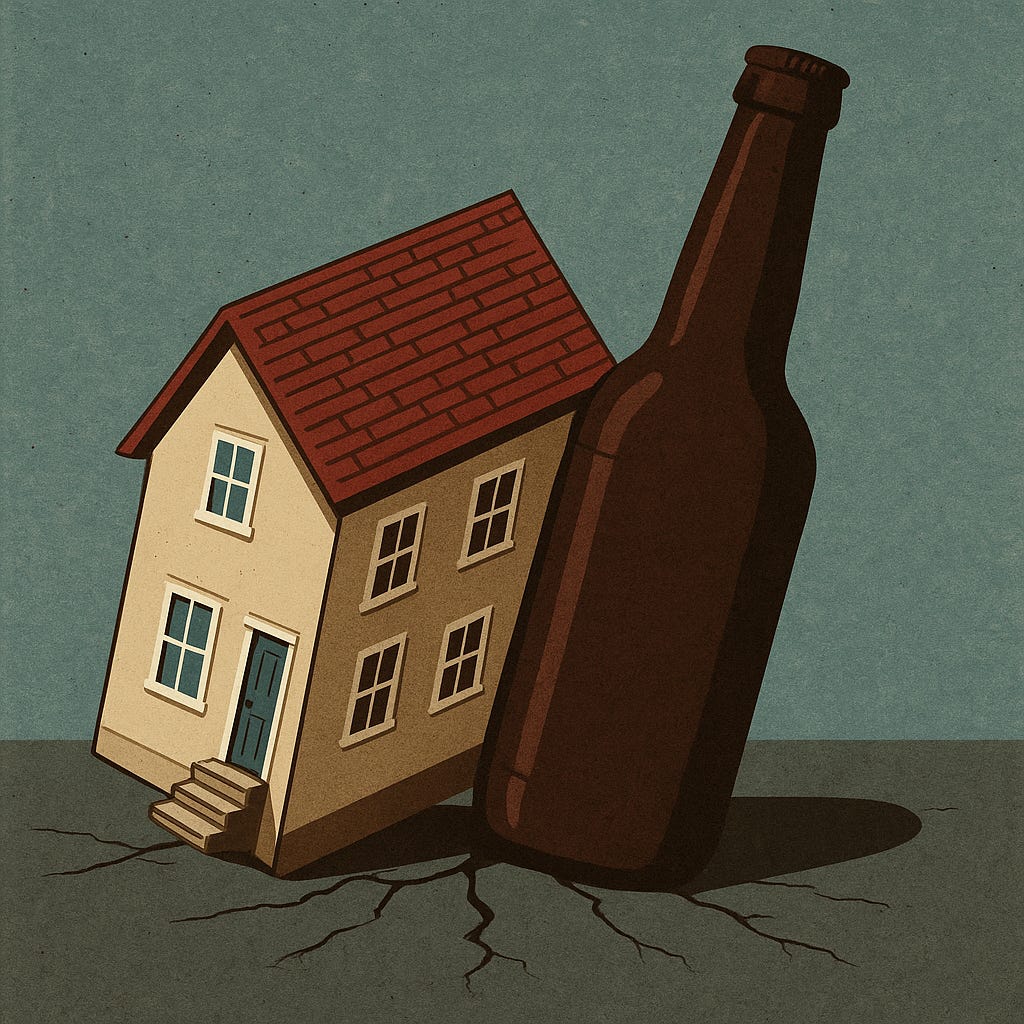
For decades, Knoxville’s housing market was defined by its relative affordability. The typical family could reasonably expect to afford a home—the quiet but powerful engine of the region’s growth. That era is over. Over the course of the past decade, and really the last five years, the balance between what homes cost and what families can afford has been fundamentally upended. The surge in prices during and after the pandemic, compounded by the sharp rise in mortgage rates, has pushed homeownership further out of reach for thousands of would-be buyers. What was once Knoxville’s economic advantage—an affordable path to the middle class—has now become one of its greatest challenges.
For some, the housing boom felt like a windfall; for others, it was a slow-motion car wreck. The good news is the boom is over—but the hangover is raging on.
Affordability Gap
Until 2022, there had never been a time in Knoxville’s history when the median sale price exceeded what the typical family could afford. Yet, as of September 2025, the median sale price exceeded the affordable home price—or the maximum price a family could afford without spending more than 30% of their income on housing—by more than $40,000. That is down from a gap of nearly $75,000 in June 2025, the largest on record.
The affordability gap is largely driven by the combined effect of rapidly rising homes prices and higher mortgage rates. Over the past three years, housing costs have grown far faster than household earnings, eroding purchasing power for both first-time buyers and move-up buyers alike. From 2010 to 2019, the 30-year fixed mortgage rate averaged just 4.1% and exceeded 5% only a handful of times—a low-cost borrowing environment that supported steady, predictable growth. But beginning in 2022, in response to the worst inflationary spike since the 1980s, tighter monetary policy pushed mortgage rates sharply higher. Since then, they’ve averaged roughly 6.4%, dramatically changing the math for would-be buyers.
Mortgage rates are forecasted to experience a slow but sustained decline over the next two years, which could help narrow the gap between what homes cost and what families can afford. In theory, a two percentage-point reduction in rates would be enough to bring affordability back within reach for many households. But in practice, such a significant drop would also unleash a surge in pent-up demand, exerting upward pressure on prices and offsetting at least part of the affordability gains. Falling rates may ease the pressure—and make for a much less anxious real estate industry—they won’t solve the underlying imbalance between supply and demand that created the gap in the first place.
Price-to-Income Ratio
Unlike the affordable vs. median home price comparison, the price-to-income ratio strips away the noise of interest rate fluctuations and demand-side subsidies, offering a more durable measure of affordability. When home prices rise significantly faster than incomes, the ratio reveals the strain that markets place on ordinary buyers, especially those trying to purchase their first home. In healthy markets, the price-to-income ratio typically hovers between 2.2 and 3.5—a level where a middle-class household can reasonably aspire to own a home without financial strain. But when the ratio exceeds 4.0, it signals growing affordability challenges.
Knoxville’s housing market for decades maintained a sense of balance, avoiding the boom-bust cycle that is common in many other cities, with the region’s price-to-income ratio hovering around 3.3 from 1980 to 2015. But that equilibrium began to shift in the mid-2010s, with the ratio inching up to 3.8 by 2020. Then came the pandemic—and with it, an unprecedented surge. By 2024, the price-to-income ratio climbed to an all-time high of 5.1. The spike was not driven by a speculative bubble or sudden collapse in wages, but by a deeper, structural imbalance: too many people chasing too few homes.
Land Prices
Why we aren’t building more $250,000 homes in East Tennessee? Land, land, land.
Land costs are one of the main drivers of housing prices—and unlike labor or materials, land is a finite resource. You can’t make more of it. Like many mid-sized metros experiencing strong population growth, Knoxville has seen land prices soar over the past decade. In 2012, the value of a quarter-acre lot in the Knoxville metro area was about $29,900, accounting for just 23.7% of a typical home’s value. By 2024, that same lot averaged $164,600, making up more than half—52.9%—of the cost of a typical home.
This rapid escalation in land values fundamentally reshapes what kinds of homes can be built, and the price appreciation among those that already exist. When the land alone costs more than $100,000, it is virtually impossible to deliver a finished home at $250,000 once construction costs, infrastructure, and regulatory expenses are factored in.
Compounding the challenge is how land is used. Local zoning policies, large minimum lot-size requirements, and infrastructure constraints effectively limit how many homes can be built on any given parcel. As a result, the high cost of land gets spread over fewer units, driving the per-home price even higher. Under present conditions, the math simply no longer works for modestly-priced housing.
Home Sales
Despite improving inventory conditions and slightly lower mortgage rates, home sales across Knoxville remain sluggish—a reflection of persistent affordability challenges and broader economic uncertainty that is keeping many potential buyers on the sidelines. While inventory has ticked up considerably and mortgage rates have inched down from their recent highs, these shifts have not been sufficient to fully offset the sharp erosion in buyer purchasing power over the past three years.
As of September, the pace of home sales has improved modestly but remains roughly 25% below its 2022 peak and about 10% lower than pre-pandemic levels. Current sales activity is hovering around 2015 levels—which was, by all accounts, a fairly strong year for the Knoxville housing market. But unlike 2015, today’s market is grappling with much higher prices and an entrenched lock-in effect, creating a stasis in which existing homeowners are reluctant to give up their lower mortgage rates, and first-time buyers struggle to qualify at current prices.
Home sales volume is poised to improve over the next two years, even if mortgage rates do not fall as quickly as some forecasters once anticipated. As new inventory continues to hit the market and incomes slowly catch up, more buyers will likely return to the market. However, sales are unlikely to surpass the feverish post-pandemic boom anytime soon. That period was defined by extraordinarily low interest rates, an influx of out-of-market buyers, and a surge in demand that pushed the market to unsustainable highs—a unique set of trends that aren’t likely to coincide again soon.
Housing Inventory
The number of homes listed for sale in the Knoxville region is appreciably higher than at any other point in the past five years, marking a notable shift from the historically tight inventory conditions that defined much of the last five years. Even so, inventory remains roughly 40% lower than it was a decade ago—despite the region experiencing sustained population growth in the intervening years.
Still, the uptick in active listings has afforded buyers much more leverage, restoring some semblance of balance to the buyer-seller relationship. Homes are, on average, staying on the market a lot longer (although a quality, well-priced home can still move quick), and price reductions are more common. Buyers who just a year or two ago faced bidding wars and opted to waived contingencies as a means to make their offer more attractive now have space to use more discretion and still be competitive.
The shift in conditions hasn’t yet materialized into a full-fledged buyer’s market, but it has helped restore a measure of equilibrium to the buyer–seller relationship. In my opinion, the additional inventory has brought a welcome moderation to what had become an unsustainably hot market—offering some relief for buyers without undermining the stability of home values. With builders ramping new home production, housing inventory should continue to grow steadily over the next five years, with growth slated to slow as mortgage rates fall. The good news is more inventory is on the way; the bad news is that it won’t be nearly enough.
Final Thoughts
No matter how you look at it, the past five years have been a remarkably turbulent period for the housing market and the broader real estate industry. Going into 2020, the housing market was well-position for strong but steady growth before the onset of the COVID-19 pandemic, which at first caused a dramatic decline home sales and then an utter explosion of market activity. For over two years, the market was red-hot and routinely outpaced even the highest of expectations. But the boom was ultimately stopped in its tracks by a historic bout of inflation.
Adding fuel to the fire, in 2024, the National Association of Realtors agreed to a massive $418 million settlement in a class-action antitrust case alleging that NAR’s rules forced home sellers to pay inflated commissions. While the settlement did bring structural changes to how agent compensation and MLS disclosures operate, it didn’t—and won’t—bring the type of seismic change some real estate industry commenters predicted.
Even more, with the housing market hangover in full effect, NAR last week repealed its policy that required local MLSs to mandate membership in a Realtor association as a condition of access—broadly recognized as a move to avoid yet another massive antitrust suit. Under the new rules, access to an MLS “is a matter of local discretion,” so each MLS can decide whether to require belonging to a Realtor association for access. Unlike the commission settlement, this decision may in fact bring the seismic change many expected—felt more acutely by real estate practitioners than by consumers.
What’s clear today is that change is coming, both in market conditions and in the governing structure of the real estate industry itself. After all, change is inevitable.