


Last Thursday evening, Politico reported that the Federal Aviation Administration is working to acquire an ownership stake in Air Space Intelligence, a private-held startup whose artificial intelligence-powered tool helps air traffic controllers manage congestion. The FAA awarded the company a sizable contract in June, and the system has been deployed at three Washington-area airports since September.
The potential deal raised some eyebrows, if only because the federal government rarely buys into private companies. But it is no longer rare. Since June 2025, the U.S. government has announced plans to take equity stakes in 36 private U.S. companies including Intel, U.S. Steel, and MP Materials, according to the CATO Institute’s Government Ownership Dashboard. The closed transactions and announcements amount to billions and billions of dollars.
That deals like these are happening at all is notable, but the pace of the government’s equity portfolio expansion has been staggering. Just in the week or so I spent writing this, I had to update the piece because yet another deal was announced: this one between the Department of War and Wolfspeed, Inc., a publicly traded developer and manufacturer of semiconductors. New deals aren’t the only way the portfolio is growing, either. Earlier this month, President Trump announced the government plans to expand its existing stake in another semiconductor manufacturer, GlobalFoundries, bringing the government’s holding to more than $2 billion.
The idea itself is not new, though until recently it was once largely confined to one party. In recent years, prominent Democrats including Alexandria Ocasio-Cortez and Gavin Newsom have supported government ownership stakes in key industries. U.S. Senator Bernie Sanders, a self-proclaimed democratic socialist, went so far as to publicly praise the Intel deal, which gave the government 10% ownership, and the administration’s wider effort to convert federal grants into government equity stakes.
Still, the vast majority of Republicans and Democrats alike have generally viewed government ownership as anathema, pointing to the risk of political favoritism, conflicts of interest, and distorted competition. That skepticism is central to the American free-enterprise tradition and is much of what separates it from economies elsewhere in the world.
It is no surprise, then, that opponents of the wave of new government equity deals have evoked a word now widely deployed by Republican campaigns across the country: socialism. In a true socialist economic system, almost all major industries are partially or fully-owned owned by the state. Thirty-six equity stakes are not that. But the government’s rapidly expanding portfolio is at least a small step in that direction.
Americans aren’t exactly enthralled by the idea, either. About 67% of Americans say the federal government should not be able to take ownership stakes in private companies, according to a recent survey by the Economic Innovation Group and Echelon Insights.
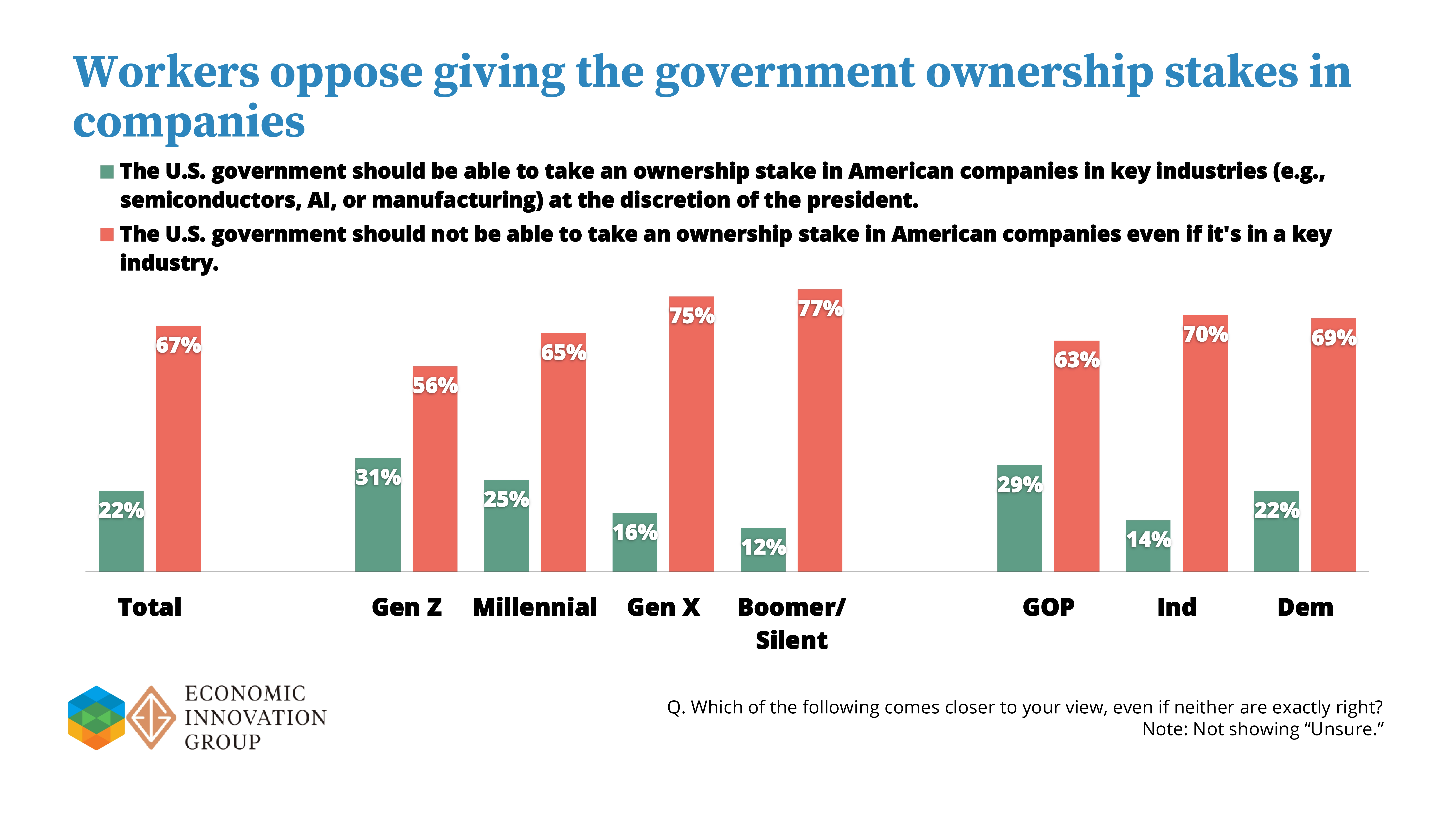

Especially notable is that opposition is consistent across parties and generational groups. Gen Z respondents, who are roughly 15 to 30 years old today, are most open to the idea, though still only 31% explicitly support it.
Government ownership of private companies is not without precedent, but it has mostly been confined to times of economic crisis. The 2008 financial crisis is the most recent example. As markets tumbled, the federal government took a nearly 80% stake in the global insurer AIG, and, through the auto bailout, acquired a 61% stake in General Motors. Those interventions were extraordinary responses to a devastating economic crisis—and deeply divisive at the time. Notably, both were explicitly authorized by Congress and the government quickly sold out of both positions.
There is, of course, a material difference between using government funds to stabilize an economically critical industry during a crisis and making government ownership a routine tool of domestic economic policy. When the government becomes a shareholder, it gains a direct financial interest in a company’s success. That interest conflicts with the government’s other roles as regulator and policymaker—even when the investment carries no formal management role. The FAA case illustrates the problem: the agency would simultaneously be the company’s regulator, largest customer, and part-owner.
Even a minority stake invites questions about whether a company is receiving favorable treatment, whether its competitors are being disadvantaged, and whether political considerations are shaping decisions that should be left to the market. The risk is not limited to overt favoritism, either. If an investment doesn’t pan out, there is an incentive for the government to provide additional support rather than accept a loss—an incentive that’s even stronger if the company is viewed as serving a critical economic or national security interest. An initial investment, then, can become a continuing commitment.
Supporters argue that these investments can help bolster domestic supply chains and manufacturing and advance national security—and that if taxpayers are already funding companies through grants, they deserve a share of the upside. That’s a serious argument. The government’s Intel stake, for instance, is now worth several times what it paid.
But whether or not the government makes a profit from these deals isn’t the same as whether it’s sound economic policy, nor does it resolve the broader questions: Who authorizes these investments or at what point are the deemed justified? What safeguards exist to prevent preferential treatment and ensure government can adequately separate its financial interests from its public responsibilities? And when and how does the government get out?
The central question, to me, is not whether a particular crisis might ever justify government intervention. There may be times when such action is warranted, and when it is, those decisions ought to be made on their merits, case by case, with Congress’s explicit authorization and a clear exit plan.
But that is not what is happening now. Thirty-six equity deals in sixteen months is a clear shift toward treating government ownership of private companies as a routine tool of domestic economic policy, exercised at the discretion of the executive branch, with dubious authority and no real guardrails. And that sort of policy reversal deserves a level of public scrutiny and debate it has not yet received.
Support My Work
This publication is free and publicly accessible to everyone.
That doesn’t mean it’s free to produce. Behind each article are real costs—from data subscriptions and software to research tools and analysis—and, to date, I’ve covered those myself.
If you find this work valuable, please consider making a donation of any amount. Every donation goes exclusively toward supporting and expanding this publication, not to benefit me personally. Your support helps keep this work free and accessible to all.