

Local political and business leaders have long talked about Knoxville’s “brain drain” problem. Our region’s best and brightest attend the University of Tennessee, then pack their bags upon graduation and head to cities like Atlanta, Nashville, or Washington D.C. in search of higher paying jobs and more fun. For a long time, Knoxville simply couldn’t provide the sort of amenities—or salaries—needed to compete with bigger, flashier cities.
That “brain drain” carries real economic consequences. When UT graduates leave, the region loses more than their degrees. It loses future entrepreneurs, homeowners, civic leaders, and taxpayers. Young professionals are disproportionately likely to start businesses, form families, buy homes, and anchor neighborhoods. Their presence creates the density of talent that attracts employers in the first place.
In mid-sized metros like Knoxville, even modest outflows of educated workers ripple outward: employers struggle to scale and emerging industries look to more talent-rich cities, culminating in slower growth and economic stagnation. Over time, that erosion compounds. Cities that cannot retain their workforce talent slip into decline—and once that cycle sets in, it is notoriously hard to reverse.
For decades, a consistent outflow of high-skill, educated workers kept Knoxville’s economy from reaching its full potential. But data from recent years suggest that is changing. From 2019 to 2024, Knoxville saw its population aged 25-34 grow by 14%—the strongest growth in the state and far exceeding the 5% growth from 2015 to 2019. It has also outpaced most peer cities, including economic rivals Nashville (8%) and Greenville, SC (8%).
That double digit growth didn’t happen by accident. Over the past decade, Knoxville leaders placed renewed focus on attracting and retaining young people. While relative affordability was always a competitive advantage, the city lacked many of conventional “big city” amenities—Knoxville, after all, earned its nickname as the “Scruffy City” and long lacked the flash and scale of larger metros. Even today, the city’s nightlife is modest, the urban core can be quiet after business hours, and the job market is thin at the higher end.
But over the last decade, a renewed focus on downtown reinvestment, public-private partnerships on civic infrastructure projects like Covenant Health Park and the Urban Wilderness, the steady expansion of companies looking for early-career professionals (e.g., Axle Logistics, CGI Group, Tombras, and others), and the gravitational pull of institutions like Oak Ridge National Laboratory and the adjacent “Nuclear Valley,” where scores of nuclear-focused startups have clustered into something resembling a mini Silicon Valley, have reshaped the region’s trajectory.
All of these developments have played a role in helping transform East Tennessee into a place where high-skill young people can realistically envision building a career, launching a company, and climbing the economic ladder without feeling as though they must leave for a bigger city. That is a remarkable shift from where we were a decade ago.
Yet for all the benefits strong civic infrastructure and lifestyle appeal might bring, economic considerations like affordability tend to be the stronger driver of migration trends. And on that front, Knoxville is facing some real challenges.
Knoxville’s relative affordability has long been a strong competitive advantage. For more than a decade—from 2008 through 2019—earnings and home prices in Knoxville moved in tandem, with both rising about 22% in just over a decade.
Then the pandemic happened.
Earnings didn’t stagnate. They continued to grow at a relatively strong pace—up 21% between 2020 and 2024, meaning incomes rose nearly as much in just four years as they had in the entire preceding decade. But home prices broke away entirely, underscoring the consequences of years of underbuilding.
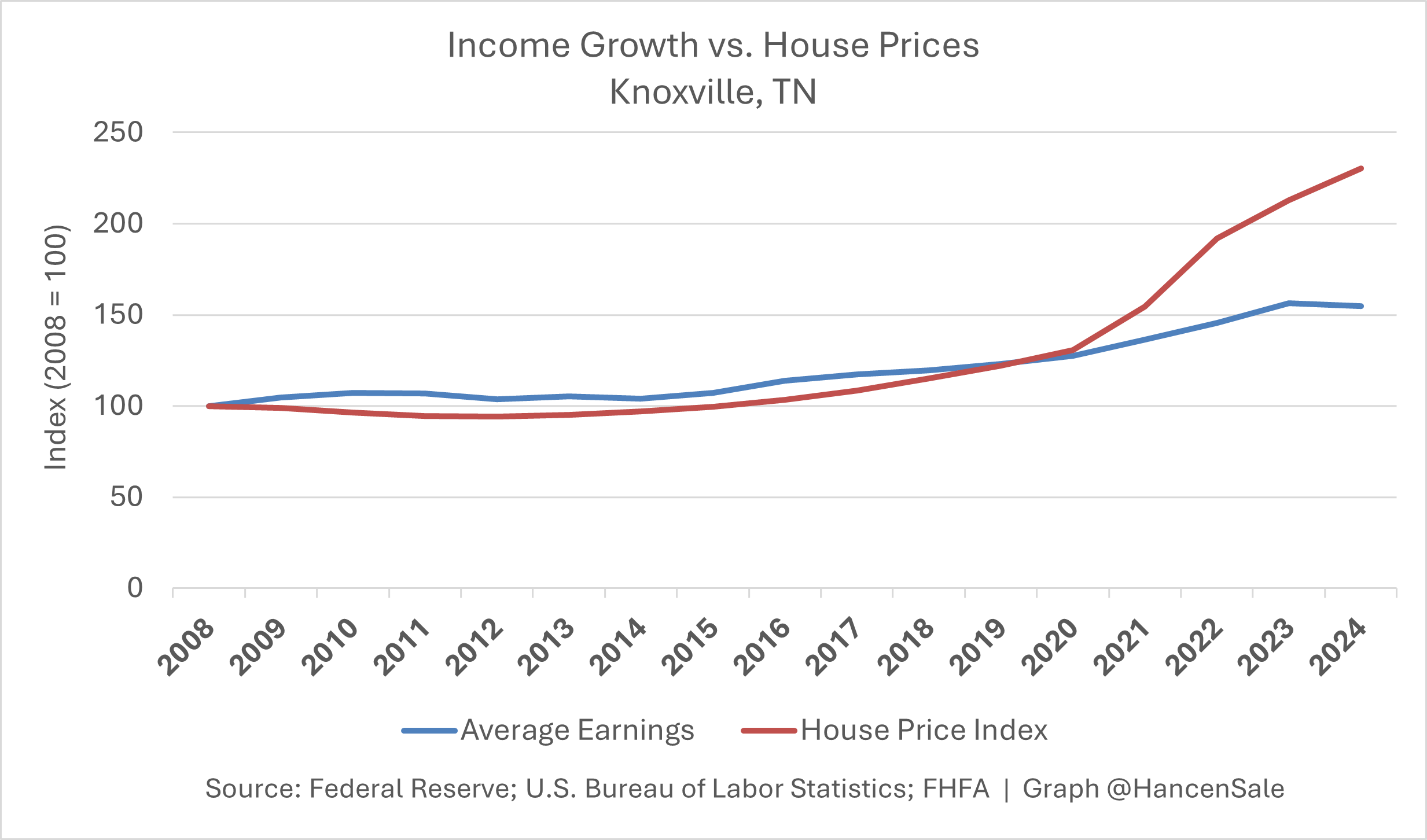
From 2020 to 2024, home prices surged 76%—more than 3.5x faster than earnings. What had long been a stable relationship between incomes and home values completely diverged, pushing prices far beyond what many long-time residents can reasonably afford and, equally as important, what young professionals can afford.
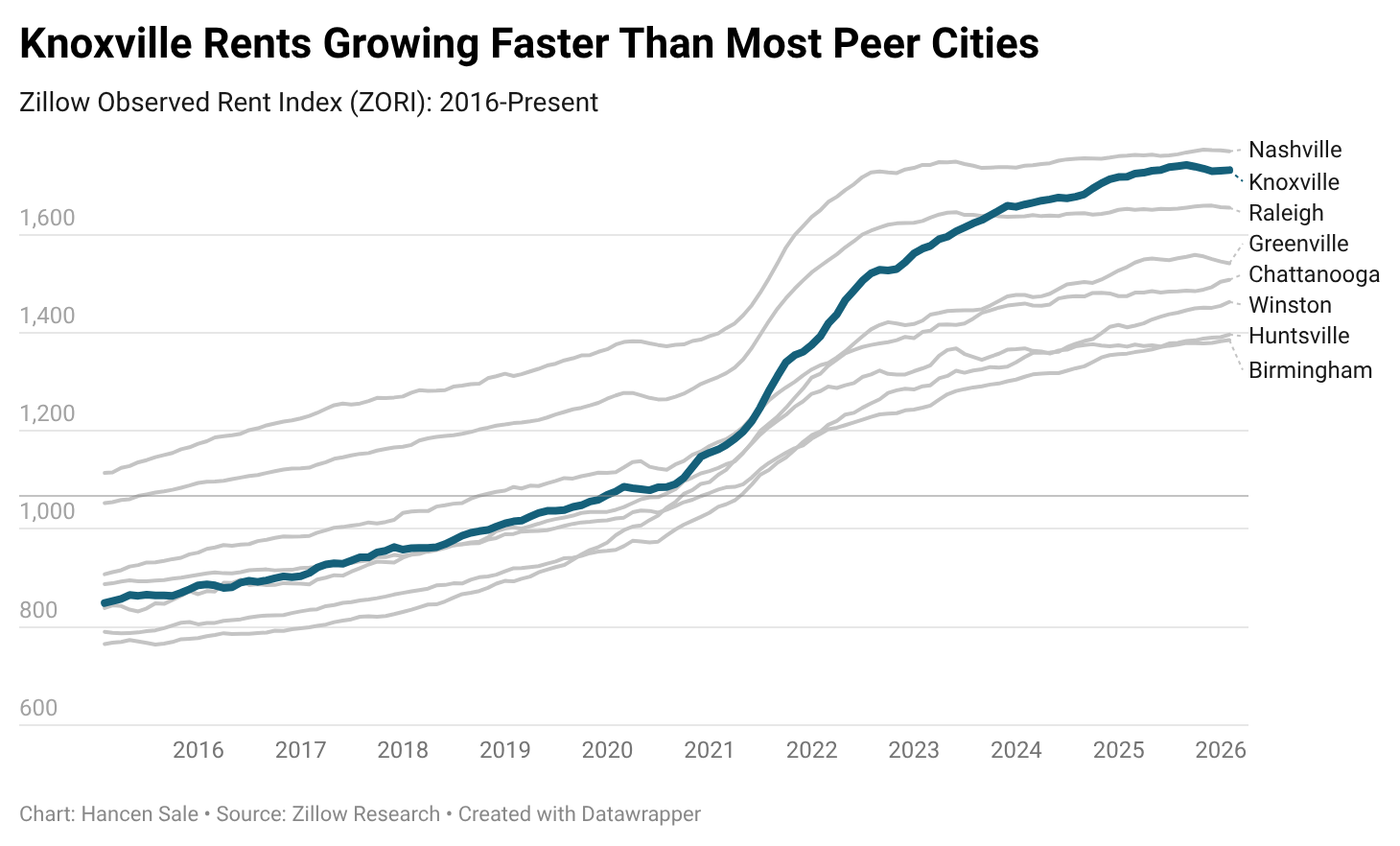
Take Nashville—one of Knoxville’s foremost competitors in terms of talent attraction—as an example. Prior to 2021, Nashville rents were always at least 30% higher than Knoxville’s. But that gap narrowed considerably over the past several years, with Nashville rents just 2% higher than Knoxville as of the beginning of 2026.
Yet despite the convergence in housing costs, household incomes in Nashville remain more than 20% higher than in Knoxville. The disparity is even greater for nonfamily households—which includes people living alone or with a roommate—with an income-gap of more than 26%. In other words, the housing cost discount that once compensated for lower wages and smaller city amenities has all but disappeared.
And the trend isn’t confined to Nashville. Since the onset of the pandemic, Knoxville has seen rents far outpace most of its peer cities with rents climbing 61% since the beginning of 2020—well above the 39% average among peer cities. Notably, median rents in Knoxville are 5% higher than in Raleigh, NC, where the median household income is $27,960—or 38%—higher than in Knoxville.
For a recent graduate comparing job offers, a slightly smaller paycheck can be justified if rent is dramatically cheaper. It is far harder, however, to justify when housing costs are nearly the same but wages are not. And if Knoxville loses its relative affordability without achieving wage parity with larger metros, as current trends suggest, the brain drain problem could quickly return. Thus, the very demographic we have worked so hard to attract—early-career and high-skill talent—will once again have reason to look elsewhere.
For years, local leaders focused on boosting Knoxville’s “fun factor,” investing in downtown vitality, outdoor amenities, and civic infrastructure to make the city more livable and competitive. That work mattered. It helped change the narrative.
But today the challenge is different. Demand is no longer the problem. People want to live here. The question now is whether they can afford to stay.
The best, and likely the only, way to restore some semblance of balance is to create and sustain an economic and regulatory environment that allows both private and public actors to flood the market with new supply of all kinds—subsidized, market-rate, single-family, multifamily—at a scale sufficient to slow price growth long enough for earnings to catch up.
There is no shortcut around the math. We can debate secondary factors or pursue politically satisfying distractions, but until we confront the structural shortage itself, affordability will remain elusive. And if we don’t act soon, the brain drain that has long plagued the Scruffy City may very well return.