

Editor’s Note: The article has been updated to reflect new information about the projected certified tax rate following the upcoming countywide reappraisal.
As the local election season heats up, property taxes are once again a key issue among the candidates running to be the next Knox County Mayor. The candidates have differing opinions on the issue—but to fully grasp each candidates’ position, it’s important to understand how Tennessee’s property tax system actually works.
How Your Property Tax Bill is Calculated
Property taxes in Tennessee are calculated using a simple formula—but it’s one most people never see laid out clearly. Here’s how it works, step by step.
1. Start with your home’s appraised value
This is what your property is estimated to be worth if you were to sell it on the open market. The appraised value is determined by the Knox County Property Assessor’s office and updated every two years.
Let’s say your home has an appraised value of $400,000
2. Apply the assessment ratio (25%)
You aren’t taxed at the full value of your home. In Tennessee, residential property is assessed at 25% of the appraised value.
$400,000 appraised value → $100,000 assessed value
3. Apply the tax rate (per $100 of assessed value)
Local governments set a tax rate expressed as dollars per $100 of assessed value. Knox County’s property tax rate for fiscal year 2025-2026 is $1.55 per $100 of assessed value:
$100,000 ÷ 100 = 1,000
1,000 × 1.55 = $1,550 annual tax bill
Now, you need to understand how the tax rate is set.
How Tennessee’s Certified Tax Rate System Works
The Knox County Property Assessor’s office conducts a countywide reappraisal every two years, updating the value of every property. Home values almost always rise, and if the tax rate stayed the same, most homeowners would see their tax bill increase by roughly the same percentage as their home’s value.
For example, if a home’s value rises from $300,000 to $400,000 (a 33% increase), and the tax rate remains $1.55 per $100 of assessed value, the annual tax bill would rise from about $1,162 to $1,550—an increase of roughly $388, or 33%.
But that’s not usually what happens in practice. That’s because Tennessee uses a Certified Tax Rate system, often referred to as a “truth-in-taxation” law. After a reappraisal, the state requires local governments to lower the tax rate so that total property tax revenue stays about the same as before (excluding new construction).
Think about it this way: If a county was generating $1 billion in property tax revenue before reappraisal at a rate of $1.55, and total property values rise by 25%, the tax rate must be reduced to a level that still produces about $1 billion—not $1.25 billion. That lower, adjusted rate is the certified tax rate. As a result, most homeowners see only modest changes in their tax bill after a reappraisal. Some pay more, some pay less, depending on how their property value changed relative to the countywide average—but the system as a whole is designed to avoid a sudden, across-the-board tax increase.
So Now the Politics…
There will be a countywide reappraisal in 2026. According to a source familiar with internal deliberations, the county property assessor’s office expects property values to increase by roughly 50 percent.1 Under Tennessee’s certified tax rate system, the tax rate must be adjusted downward after a reappraisal so that total property tax revenue remains approximately neutral (excluding new construction). Based on current estimates, that would reduce the county’s rate from about $1.55 per $100 of assessed value to roughly $1.03 per $100 of assessed value.
What to do after the tax rate falls is where the mayoral candidates disagree.
Some candidates have suggested maintaining the current $1.55 rate rather than adopting the lower certified rate, which would increase the county’s property tax revenue by over $160 million. Supporters of this approach generally view it as a way to better fund services—such as schools, infrastructure, and public safety—without raising the tax rate. Their argument is driven by new data which shows that, due to strong inflation and sluggish revenue growth, Knox County today spends 20% less per person (excluding education) than it did in 2000.
Others strongly oppose that approach and argue that it amounts to a de facto tax increase. They support adopting the certified rate (~$1.03). Under this option, most homeowners would see relatively modest changes in their tax bills, aside from differences based on how their individual property value changed relative to the county average.
It’s worth noting that the County Commission—not the Mayor—sets the property tax rate. The mayor proposes the budget, and commissioners have historically deferred to those priorities, but the final decision rests with the Commission. Raising the rate requires only a simple majority, and while the Mayor can veto the measure, the Commission can override with a simple majority plus one—rendering the Mayor’s veto power far less consequential than it might seem.
To better illustrate how changes in the tax rate affect property tax bills, the table below shows the annual difference across a range of home values. For example, a homeowner with a current appraised value of $300,000 would see their annual bill increase by an average of $581, or an additional $48 per month, if the county were to maintain the current rate instead of adopting the lower certified rate.
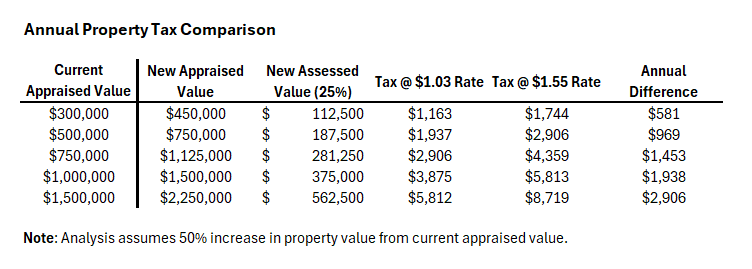
As home values rise, that difference grows proportionally. A $500,000 home would see an increase closer to $900–$1,000 per year, while a $1 million home would see an increase of roughly $1,900–$2,000 annually. In other words, the impact of holding the higher rate is not uniform—it scales with property value. For some households, the difference may feel modest. For others, particularly those on fixed incomes or in rapidly appreciating neighborhoods, it can be much more significant.
This is where the political obfuscation comes in. Candidates who favor maintaining the current rate can accurately say they are not raising the tax rate, which is often how tax increases are traditionally defined. But because property values—and therefore assessed values—have risen, keeping the same rate is a de facto tax increase because it would result in higher tax bills for most all homeowners. On the other side, candidates who support adopting the certified rate frame it as preventing a tax increase, which is mostly true, even though some individual tax bills may still rise depending on how one’s property value changes relative to the countywide average.
Both arguments have basis in how the system works, but they emphasize different parts of it—one focusing on the rate, the other on the final bill. For voters, understanding that distinction is essential to cutting through the political rhetoric and evaluating what each position actually means in practice.
Even Maintaining the Rate Wasn’t an Option Last Time
A useful recent example comes from Mayor Indya Kincannon during the City of Knoxville’s last reappraisal.
In April 2022, Mayor Kincannon proposed a 50-cent increase to the City’s property tax rate to generate additional revenue for core services and public safety. But that proposal came with an important caveat: a countywide reappraisal was approaching, which would trigger a lower certified tax rate.
As expected, property values rose significantly, and the certified rate was recalculated downward. When the City ultimately adopted its new rate, it dropped from $2.9638 to $2.1556 per $100 of assessed value—the lowest rate Knoxville has seen since 1974. In effect, the originally proposed increase was partially offset, with the net impact landing closer to 36.5 cent tax increase, not the full 50.
But the sequencing matters. Because the City raised the rate before the reappraisal, it effectively increased the baseline from which the certified rate was calculated. Had the City not enacted that initial increase, the certified rate would have reset from a lower starting point—resulting in an even lower final tax rate. In that sense, the final rate is both lower than the pre-reappraisal rate and higher than it otherwise would have been without the prior 50 cent increase.
The key point is this: simply keeping the prior rate was never treated as a neutral option. Doing so would have effectively doubled most resident’s property tax bills—a dramatic, across-the-board tax increase that not even the City was willing to accept. The result, then, is a bit counterintuitive: Knoxville residents are paying a lower tax rate than they have in decades, while still paying higher tax bills.
Some Final Thoughts
Property taxes are one of the most visible—and most misunderstood—parts of local government. Much of the confusion comes down to a simple disconnect: people hear about tax rates, but what they ultimately feel is their tax bill. In a system like Tennessee’s, those are not the same thing.
The mechanics matter. Rising property values usually increase the tax base, but Tennessee’s certified rate process is designed to reset that base and prevent automatic revenue growth. And the decision of whether to adopt that lower rate—or maintain a higher one—is not a technical adjustment. It’s a policy choice with real tradeoffs.
Those tradeoffs are worth stating plainly. Maintaining a higher rate can provide local governments with needed revenue to keep up with growth, invest in infrastructure, and maintain service levels in a rapidly growing county. At the same time, adopting the certified rate prioritizes predictability for taxpayers and guards against increases that are driven solely by rising home values rather than deliberate policy decisions.
Neither approach is inherently right or wrong. But they are fundamentally different. And that’s why clarity matters. When candidates say they are “not raising taxes,” they may be referring to the rate. When homeowners say their taxes are going up, they are referring to their bill. Both can be true at the same time.
Understanding that distinction is the key to cutting through the rhetoric and having a more honest conversation about how we fund the services community relies on.
The projected increase in property values of 50% following the 2026 countywide reappraisal is based on preliminary estimates by the Knox County Property Assessor’s office, according to a source familiar with internal deliberations. This figure is subject to change.