


It’s a cliché, but it’s true: the secret is out. Knox County is one of the fastest-growing counties in America. It is also, by some measures, one of the most fiscally unprepared for that growth.
Since the Great Recession, the county’s economy has consistently outpaced the nation, averaging 3.0% annual real GDP growth since 2010 compared with 2.4% nationally. That trend only intensified after the pandemic: since 2021, local real GDP has grown at an average annual rate of 5.3%, compared with 3.6% nationally—meaning the local economy has, on average, grown almost 50% faster than the country overall in recent years.
The current wave of growth did not appear overnight. Momentum began building around 2015 and has only accelerated since.
That growth has delivered real dividends. Expanded air service, including Southwest Airlines, and the arrival of national brands like Nordstrom Rack, Whataburger, Topgolf, and In-N-Out Burger are direct byproducts of a larger, more dynamic regional economy. Without it, many of the amenities residents now enjoy simply wouldn’t exist.
But rapid growth has also exposed—and deepened—serious challenges.
Home prices and rents have vastly outpaced income growth, pushing homeownership out of reach and making it harder for longtime residents to climb the economic ladder. As a result, the median sale price has exceeded the affordable home price—or the maximum price a typical family could afford without spending more than 30% of their income on housing—for 40 consecutive months, as of January 2025.
In addition to the rising cost-of-living, other quality of life measures have slowly deteriorated. Traffic congestion, one of the most widely cited concerns among voters, has reached historic levels. Meanwhile, the county has identified roughly $1.7 billion in local road-improvement projects yet today, under current budget constraints, can afford to repave less than 50 miles of roads per year, at a budgeted cost of roughly $15 million per year.
Even more, despite Knoxville being a fraction of Nashville’s size, TDOT officials have said the 17-mile stretch from the I-40/75 split to the I-640 interchange in Knoxville is the busiest stretch of interstate in Tennessee—with no easy solutions on the horizon, especially in a state like Tennessee that utilizes a “pay-as-you-go” model for road improvements.
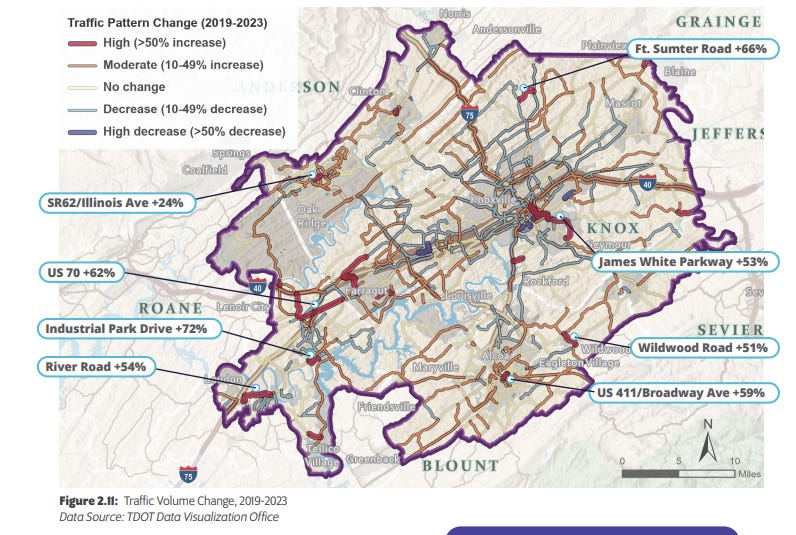
While many roadways are controlled by the state, data from the Knoxville Regional Transportation Planning Organization show regional arterials have experienced the greatest increases in traffic volumes in recent years. That increase in traffic and underinvestment in road infrastructure is, in part, why there was a life-altering traffic crash every 15 hours in the region from 2016 to 2021—a number that has likely increased over the past 4 years.
Yet these pressures are not simply the inevitable side effects of growth. They also reflect deeper budgetary changes: Knox County’s public infrastructure and fiscal capacity have not kept pace with the speed of its own growth. Much like the local housing market, rapid economic expansion and population growth has overwhelmed the region’s infrastructure, which was already lacking even before the pandemic made Knoxville a premier relocation destination.
And the core problem is fiscal. Rising debt service payments and sluggish revenue growth have steadily eroded the county’s ability to fund basic services—things like road paving, stormwater upgrades, and deferred maintenance—even as demand for them has surged.
The numbers tell a stark story. From 2000 to 2024, the county’s operating budget increased by an inflation-adjusted 23%, while the population grew 33% over the same period.
But even that modest budget growth is misleading. Strip out state-driven education funding—which reveals a clearer picture of dollars available for infrastructure and county services—and the operating budget has grown by just 7% since 2000. The result: Knox County today spends roughly 20% less per resident (excluding education) than it did in 2000—$799 per resident compared with $1,009, in current dollars. In other words, the county is trying to serve a third more people on roughly a fifth less money.
After adjusting for inflation, the non-education portion of Knox County’s operating budget is actually down 6.9% from 2010—underscoring how population growth and rising costs have steadily eroded the county’s fiscal capacity.
The scale of the county’s debt obligations are serious, too. As of 2025, Knox County carried roughly $761.23 million in outstanding principal and interest—about $1,500 for every resident. Annual debt service payments are projected to rise from $84.4 million in fiscal year 2025-2026 to $110 million by 2030, consuming nearly 10 percent of the county’s total budget and an even larger share of non-education spending.
Looking at spending relative to the broader economy tells a similar story. The total operating budget (excluding education) as a share of GDP fell from 1.5% in 2001 to just 0.89% in 2024, meaning county government spending has steadily declined relative to the size of the economy it serves. This metric, which ideally would remain relatively stable over time, decreased in 16 of the last 23 years.
A similar story emerges when spending is measured against total personal income, or the combined earnings of county residents. Because this metric reflects the income base that ultimately supports public services, it provides a useful snapshot of how large government spending is relative to taxpayers’ ability to pay, making it a much clearer indicator of fiscal burden than raw spending totals. By that measure, too, county government today represents a smaller share of the community’s overall earnings than it did 25 years ago, with county spending (excluding education) falling from 1.8% of total personal income in 2000 to just 1.1% in 2024.1
And the problem isn’t likely to get better. According to a source familiar with internal deliberations, the county property assessor’s office expects property values to increase an additional 50% after the 2026 reappraisal. Under Tennessee’s certified tax rate system, that would push the county’s nominal property tax rate down to roughly $0.80 per $100 of assessed value from the current rate of $1.55—the lowest rate on record.
And Knox County already has one of the lowest effective property tax rates in the entire country, according to a study by nationwide real estate data firm Attom Data.
None of this is to say that low taxes are bad. In fact, maintaining a relatively low tax burden is unequivocally a good thing. It has long been a part of Knox County’s success, encouraging business investment and leaving more money in the pockets of residents. That matters. But low taxes are not cost-free—the costs simply accumulate elsewhere, in deferred roads, aging infrastructure, and services that don’t keep pace with a growing population.
For more than two decades, Knox County has done more with less, going 25 years without raising the property tax rate. That discipline is admirable in many ways. But the county that approach was designed for—smaller, slower-growing, with less debt and lower costs—no longer exists.
The Knox County of today has one-third more residents, a rapidly expanding economy, and infrastructure obligations that can no longer be deferred without consequence. At some point, the amenities and infrastructure that make a place attractive to business and residents—good roads, reliable stormwater systems, and public services—become more valuable to economic growth than an incrementally lower tax bill, what economists refer to as diminishing marginal returns.
Knox County may be approaching that threshold. The county’s tax rate is already among the lowest in the nation; the marginal benefit of letting it fall lower and lower is almost certainly smaller than it has ever been, while the cost of the infrastructure gaps that low rate produces is growing larger every year. The county is, in effect, trying to run a bigger government on a budget calibrated for one half its size.
The question is not whether growth will continue—by most indications, it will. And that growth will help to grow the overall tax base, but likely not fast enough to outpace the growth in labor and material costs like paving asphalt, concrete, steel, pipes, fuel, and other industrial equipment.
The real question, then, is whether a fiscal model designed for a much smaller community can meet the demands of the city Knoxville has actually become. That is a question Knox County leadership will have to face—and soon.
This trend is similar when education funding is included. The total county operating budget (including education) as a share of total personal income fell from 4.1% in 2000 to 2.8% in 2024, a decline of over 30%.